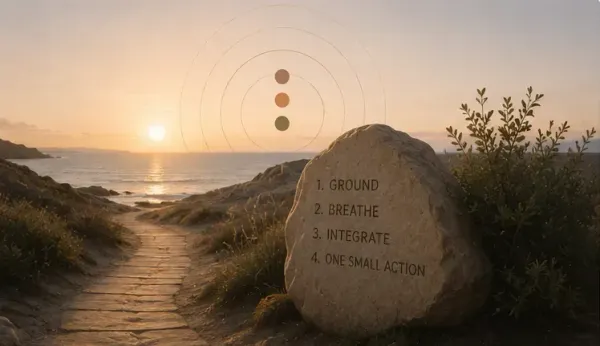
How to Do Self-Hypnosis: A Step-by-Step Beginner Method
Learn how to do self-hypnosis with a simple beginner method: arrive, focus, invite an inner signal, listen gently, and return safely.


Self-hypnosis gets explained in a lot of unhelpful ways.
Some people make it sound like stage hypnosis: blank mind, lost control, dramatic trance.
Some people make it sound like affirmations: relax, repeat a phrase, and hope your subconscious obeys.
Some people make it so mystical that beginners are left wondering whether anything “real” happened at all.
A better way to start is simpler:
Self-hypnosis, in the Inner Signal approach, is a structured way of narrowing attention, listening inward, inviting a useful inner signal or inquiry, and coming back clearly.
It does not require disappearing.
It does not require perfect belief.
It does not require a breakthrough.
A good beginner session can be small and still be real.
Before you begin
Do not practice while driving, operating machinery, caring for someone who needs your full attention, or in any situation where going inward would make you less safe.
If you are in crisis, feel at risk of harming yourself or someone else, feel severely destabilized, or are dealing with medical symptoms that need care, self-hypnosis is not the right tool for that moment. Use real human help.
This practice is for ordinary self-listening and gentle inner work.
The rule is:
Smaller, slower, safer — no breakthrough required.
Step 1: Choose one small aim
Do not start with your entire life.
Choose something small enough to hold.
Examples:
- I want to understand why I feel tense today.
- I want to meet the part of me that feels fake doing this.
- I want one phrase to carry into the day.
- I want to listen to the body signal around this decision.
- I want to be a little less cruel to myself.
A self-hypnosis session works better when the aim is narrow.
Not:
Fix my whole childhood.
Better:
What needs one inch of care today?
Step 2: Arrive in the room
Start outside the mind.
Notice three things you can see.
Notice three things you can hear.
Notice three places where the body touches the chair, floor, clothing, or air.
Let the breath be ordinary.
On one out-breath, soften one unnecessary effort: jaw, shoulders, hands, belly, face.
This step matters because self-hypnosis should not begin by leaving the world. It should begin by arriving.
Step 3: Narrow attention gently
Pick one still point: a spot on the wall, a place on the floor, a candle flame, a sound, or the sensation of the breath.
Let attention gather around it.
You are not trying to force trance.
You are giving the mind fewer places to scatter.
If your eyes want to close, let them close. If not, keep a soft gaze.
Then count down slowly from five to one:
Five — the room is here, and so am I. Four — my attention is gathering inward. Three — I am not leaving; I am listening more carefully. Two — a little quieter. One — present enough to begin.
That is enough induction for a beginner.
Step 4: Invite an inner signal
An inner signal is not something you force.
It may be warmth, tingling, heaviness, breath change, a small movement, an image, a phrase, emotion, blankness, or a quiet yes/no sense.
Ask inwardly:
If there is a useful signal today, let it come in a gentle, stabilizing way.
Then wait.
Do not stare at the body like a detective.
Do not make something happen just to prove the session is working.
If nothing comes, the signal may be “nothing obvious today.”
That counts.
Step 5: Ask one question
Ask one question only.
Examples:
What do I need to understand today?
What is this feeling protecting?
What would help me trust myself one inch more?
What does the younger part need from the adult today?
What is one small action that would make life safer or steadier?
Then listen.
The answer may not come as words. It may be a sensation, image, emotional tone, resistance, memory fragment, or blankness.
Do not force certainty.
Do not turn every image into a fact.
Do not treat a body sensation as proof of a past event.
Stay modest.
Step 6: Meet resistance as part of the work
If the mind says, “This is fake,” good.
That is something to listen to.
Ask:
What might the fake-feeling be protecting me from?
If the body goes numb, ask:
What would make this feel one inch safer?
If a critical voice appears, ask:
What is this voice trying to prevent?
Resistance is not failure.
Often, resistance is the protector part standing at the doorway. Respect it.
Step 7: Land the session
Before ending, bring back three things:
One phrase Something simple enough to remember.
One body signal A sensation or shift that marks the session.
One small action Something ordinary enough to do.
Examples:
Phrase: “I am not broken.” Body signal: warmth in the chest. Small action: take a walk before answering that message.
This step keeps self-hypnosis from becoming vague.
Step 8: Exit clearly
Do not just drift out.
Count from one to five:
One — something wants to be carried back. Two — the rest can stay safely here. Three — I am returning to ordinary life. Four — I move my hands and feel my feet. Five — eyes open, I am back.
Look around.
Move a little.
Drink water if needed.
Write down the phrase, signal, and action.
What if it felt fake?
Then you had a normal beginner session.
Self-hypnosis often feels ordinary at first.
The question is not:
Was this dramatic enough to prove I was hypnotized?
The better question is:
Did I listen differently than I usually do?
That is the beginning.
Try the guided version
Inner Signal gives you a structured way to practice this without having to remember every step.
Start with the free preview:
Try the free Inner Signal preview →
If the method fits, the full trainer gives longer sessions, no-trance inner-child mode, body-signal troubleshooting, protector handling, and safer integration.
This beginner method is Inner Signal’s style of self-hypnosis: communion rather than command. See why that matters.
Why Inner Signal? This method combines inner-child reparenting with self-hypnosis as spiritual inner communion — not command-style hypnosis, generic AI therapy, or an IFS clone.