
How to End a Self-Hypnosis Session Safely
Learn how to end a self-hypnosis session safely with grounding, re-alerting, integration, and one small action you can carry into daily life.

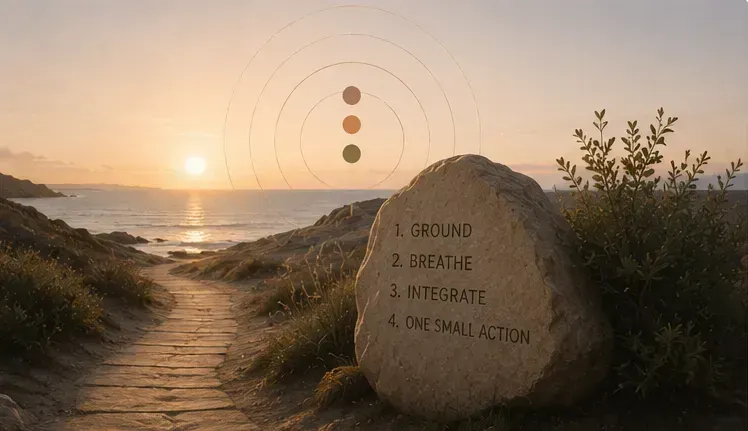
A lot of self-hypnosis guidance focuses on how to go in.
The induction.
The deepening.
The suggestion.
The imagery.
The breakthrough.
But the ending is just as important.
Maybe more important.
A self-hypnosis session should not leave you floating, foggy, wide open, or hungry for one more hit of the state.
A good session lands.
Why the ending matters
Inner work can open something.
It can bring relief, grief, warmth, insight, body sensation, memory fragments, or a younger part that finally feels heard.
That can be good.
But opening is not the same as integrating.
If you open something and then wander back into life half-disoriented, the session may not help much. It may even leave you raw.
Ending well means bringing the experience back into ordinary life.
Not all of it.
Just enough.
Do not end at the peak
If something feels really good, the temptation is to keep going.
You want more warmth.
More tingling.
More contact.
More insight.
More proof that it worked.
But the cleanest moment to stop is often when the session is whole, not when you have extracted every possible feeling from it.
More is not always better.
Sometimes more turns the session into performance or state-chasing.
A good ending says:
This is enough to carry.
The three things to bring back
Before ending, identify three things.
One phrase
This can be a sentence, fragment, or simple word.
Examples:
I am not broken.
I can go slowly.
I am here now.
The child does not have to carry this alone.
One inch more trust.
Do not make it perfect.
Make it memorable.
One body signal
Name the body mark of the session.
Examples:
- warmth in the chest
- tingling down the neck
- heaviness in the hands
- a calmer breath
- tightness in the belly
- blankness
- a small no
- a sense of space
The body signal helps you remember how the session actually felt.
One small action
This is where a lot of inner work fails.
The action must be ordinary enough to do.
Examples:
- drink water
- send one message
- clean one small area
- say no to one thing
- go outside
- stop rereading the hurtful text
- take a five-minute walk
- write the phrase down
- put your hand on your chest before sleep
Do not choose a heroic action.
Choose a real one.
The re-alerting step
If you used hypnosis, count back up.
Try:
One — something wants to be carried back. Two — the rest can stay safely here. Three — I am returning to ordinary life. Four — I move my hands, I feel my feet. Five — eyes open, I am back.
Then actually move.
Look around.
Feel the floor.
Name three things in the room.
Stretch the hands.
Orient to the date, place, and next ordinary task.
This is not decorative.
It tells the nervous system the session is complete.
If you feel too open
If you feel raw, floaty, or too open, do less inner work and more grounding.
Try:
- stand up
- feel your feet
- look at hard edges in the room
- drink water
- eat something simple
- touch a textured object
- step outside
- text a grounded person
- do a small practical task
Do not go back in to fix the openness.
Close first.
If you feel disappointed
Sometimes nothing dramatic happens.
No phrase.
No signal.
No emotional release.
The ending is still the same.
Bring back:
- one honest phrase: “Nothing obvious came.”
- one body signal: “Blankness.”
- one small action: “Stop judging the session.”
That counts.
A boring session can still build trust.
If you want to do more
Ask why.
Is there a specific question that genuinely needs attention?
Or do you mostly want the feeling again?
Both answers are honest, but they lead to different choices.
If there is a real question, you might do a very short focused round.
If you mostly want the feeling again, integration is safer.
Try:
Where could I allow 5% more of this feeling today without reopening the session?
That turns the state into life.
What not to do after a session
Avoid immediately:
- making major decisions
- sending intense messages
- confronting someone while charged
- declaring recovered memories
- doing another deep session just to chase the feeling
- using the session to avoid a real-world responsibility
- going straight into doomscrolling
- analyzing the session until it loses its body
Let it settle.
When to get help
If a session leaves you panicked, dissociated, unsafe, unable to breathe normally, flooded by trauma material, or at risk of harming yourself or someone else, stop treating it as self-practice.
Get real help.
Self-hypnosis is not emergency support.
How Inner Signal handles endings
Inner Signal is designed to land the session.
That is why it asks for:
- one phrase
- one body signal
- one small action
And why it may not encourage another deep session just because the first one felt good.
The ending is not an afterthought.
It is part of the method.
Try the free Inner Signal preview →
Clean endings are one reason Inner Signal treats hypnosis as communion rather than state-chasing. See how the method differs.
Why Inner Signal? This method combines inner-child reparenting with self-hypnosis as spiritual inner communion — not command-style hypnosis, generic AI therapy, or an IFS clone.
See how Inner Signal compares to other approaches →
A lot of self-hypnosis guidance focuses on how to go in.
The induction.
The deepening.
The suggestion.
The imagery.
The breakthrough.
But the ending is just as important.
Maybe more important.
A self-hypnosis session should not leave you floating, foggy, wide open, or hungry for one more hit of the state.
A good session lands.
Why the ending matters
Inner work can open something.
It can bring relief, grief, warmth, insight, body sensation, memory fragments, or a younger part that finally feels heard.
That can be good.
But opening is not the same as integrating.
If you open something and then wander back into life half-disoriented, the session may not help much. It may even leave you raw.
Ending well means bringing the experience back into ordinary life.
Not all of it.
Just enough.
Do not end at the peak
If something feels really good, the temptation is to keep going.
You want more warmth.
More tingling.
More contact.
More insight.
More proof that it worked.
But the cleanest moment to stop is often when the session is whole, not when you have extracted every possible feeling from it.
More is not always better.
Sometimes more turns the session into performance or state-chasing.
A good ending says:
This is enough to carry.
The three things to bring back
Before ending, identify three things.
One phrase
This can be a sentence, fragment, or simple word.
Examples:
I am not broken.
I can go slowly.
I am here now.
The child does not have to carry this alone.
One inch more trust.
Do not make it perfect.
Make it memorable.
One body signal
Name the body mark of the session.
Examples:
- warmth in the chest
- tingling down the neck
- heaviness in the hands
- a calmer breath
- tightness in the belly
- blankness
- a small no
- a sense of space
The body signal helps you remember how the session actually felt.
One small action
This is where a lot of inner work fails.
The action must be ordinary enough to do.
Examples:
- drink water
- send one message
- clean one small area
- say no to one thing
- go outside
- stop rereading the hurtful text
- take a five-minute walk
- write the phrase down
- put your hand on your chest before sleep
Do not choose a heroic action.
Choose a real one.
The re-alerting step
If you used hypnosis, count back up.
Try:
One — something wants to be carried back. Two — the rest can stay safely here. Three — I am returning to ordinary life. Four — I move my hands, I feel my feet. Five — eyes open, I am back.
Then actually move.
Look around.
Feel the floor.
Name three things in the room.
Stretch the hands.
Orient to the date, place, and next ordinary task.
This is not decorative.
It tells the nervous system the session is complete.
If you feel too open
If you feel raw, floaty, or too open, do less inner work and more grounding.
Try:
- stand up
- feel your feet
- look at hard edges in the room
- drink water
- eat something simple
- touch a textured object
- step outside
- text a grounded person
- do a small practical task
Do not go back in to fix the openness.
Close first.
If you feel disappointed
Sometimes nothing dramatic happens.
No phrase.
No signal.
No emotional release.
The ending is still the same.
Bring back:
- one honest phrase: “Nothing obvious came.”
- one body signal: “Blankness.”
- one small action: “Stop judging the session.”
That counts.
A boring session can still build trust.
If you want to do more
Ask why.
Is there a specific question that genuinely needs attention?
Or do you mostly want the feeling again?
Both answers are honest, but they lead to different choices.
If there is a real question, you might do a very short focused round.
If you mostly want the feeling again, integration is safer.
Try:
Where could I allow 5% more of this feeling today without reopening the session?
That turns the state into life.
What not to do after a session
Avoid immediately:
- making major decisions
- sending intense messages
- confronting someone while charged
- declaring recovered memories
- doing another deep session just to chase the feeling
- using the session to avoid a real-world responsibility
- going straight into doomscrolling
- analyzing the session until it loses its body
Let it settle.
When to get help
If a session leaves you panicked, dissociated, unsafe, unable to breathe normally, flooded by trauma material, or at risk of harming yourself or someone else, stop treating it as self-practice.
Get real help.
Self-hypnosis is not emergency support.
How Inner Signal handles endings
Inner Signal is designed to land the session.
That is why it asks for:
- one phrase
- one body signal
- one small action
And why it may not encourage another deep session just because the first one felt good.
The ending is not an afterthought.
It is part of the method.