Self-Hypnosis vs Meditation: What’s Actually Different?
What is the difference between self-hypnosis and meditation? Learn how each works, where they overlap, and when to use each practice.

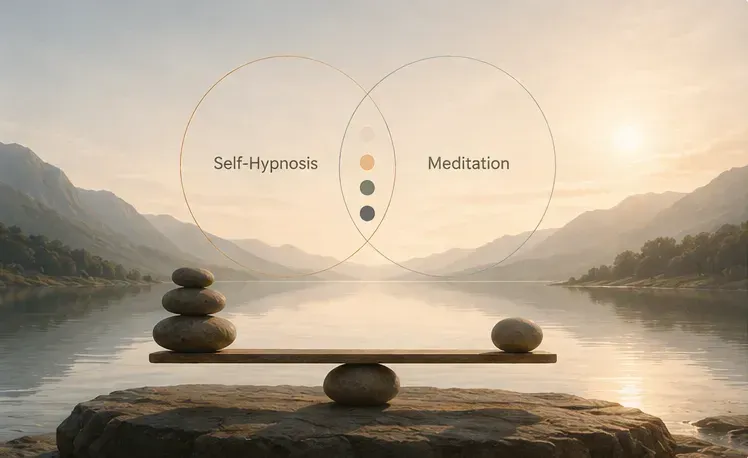
Self-hypnosis and meditation overlap.
Both can slow you down.
Both can narrow attention.
Both can change your relationship to thoughts, sensations, emotions, and the body.
Both can become part of a serious inner practice.
But they are not the same thing.
The simplest distinction is this:
Meditation trains awareness. Inner Signal uses self-hypnosis as a trance container for spiritual inner communion: focused attention used to ask, listen, receive, and return.
That purpose is not command-style programming. It may be a question, a body signal, inner-child dialogue, protector work, or a small action that lets the session land.
Meditation usually starts with awareness
In meditation, you may watch the breath, notice sensations, observe thoughts, rest in open awareness, cultivate loving-kindness, or investigate experience.
The aim depends on the tradition, but often it includes:
- seeing clearly
- loosening identification with thoughts
- cultivating compassion
- stabilizing attention
- noticing impermanence
- resting as awareness
- developing insight
Meditation may have structure, but it is often not aimed at one specific short-term suggestion.
It may be more like:
See what is true.
Inner Signal self-hypnosis is more like:
Enter a receptive state, ask inwardly, listen for what responds, and come back with one small action.
Self-hypnosis has a session arc
Self-hypnosis usually has a clearer beginning, middle, and end.
A simple session might include:
- arriving
- induction
- sensory narrowing
- suggestion or inquiry
- inner signal
- integration
- exit / re-alerting
The exit matters.
Self-hypnosis should not leave you floating.
It should bring you back to ordinary life with something usable.
That is why Inner Signal ends with:
- one phrase
- one body signal
- one small action
Meditation can become bypass
Meditation is powerful, but it can also be used badly.
Someone can become calm above the wound while the wounded inner child remains untouched underneath.
Someone can learn to observe pain without actually caring for the part that is in pain.
Someone can become very skilled at spaciousness but remain relationally immature, avoidant, dissociated, or spiritually superior.
That is spiritual bypassing.
The problem is not meditation itself.
The problem is using meditation to float away from the child instead of sending love down into it.
Self-hypnosis can become performance
Self-hypnosis has its own traps.
It can become:
- forced affirmations
- pretending a body signal happened
- chasing a good feeling
- over-interpreting images
- using trance to avoid action
- treating imagination as proof
- trying to hack the subconscious like a machine
That is not good practice.
The right attitude is not command.
It is listening.
I am not forcing the system. I am asking and noticing.
Where they meet
Meditation can prepare the ground for self-hypnosis.
If you can notice the breath, feel the body, and watch thoughts without immediately reacting, you have already built some of the skills self-hypnosis needs.
Self-hypnosis can also help meditation.
If a younger part keeps hijacking practice, self-hypnosis and inner-child work can bring love to the part that meditation alone was floating above.
The two are not enemies.
They complete each other when used honestly.
A practical difference
Try this distinction.
Meditation question:
What is happening right now?
Inner Signal self-hypnosis question:
What wants to be heard, and what small adult response would make that love believable?
Meditation may rest with experience.
Self-hypnosis may gently shape attention toward a phrase, signal, action, or inner dialogue.
Meditation says:
Notice.
Inner Signal says:
Notice, ask carefully, listen, and return.
What about inner-child work?
Inner-child reparenting can happen with or without hypnosis.
In no-trance mode, you stay conversational:
What does the younger part need from the adult today?
In self-hypnosis mode, you may enter a calmer inward state first:
Let the body signal show what is ready to be met gently.
Both can work.
Some days trance helps.
Some days plain speech is safer.
Inner Signal includes both because not every moment calls for the same doorway.
Which should you choose?
Choose meditation when you want to train awareness, presence, compassion, or insight without needing a specific outcome.
Choose self-hypnosis when you want a structured session aimed at a specific inner question, suggestion, body signal, or integration.
Choose no-trance inner-child work when you want to stay fully ordinary and speak with the vulnerable or guarded parts without deepening.
The right question is not:
Which is better?
The better question is:
What does today need?
A simple test
If you feel scattered, try meditation first.
If you feel stuck around a specific issue, try self-hypnosis.
If you feel protective, skeptical, or fake, try no-trance inner-child dialogue first.
If you feel overwhelmed, do not go deeper. Ground.
If you are unsafe, do not use either as your main support. Get real human help.
Where Inner Signal fits
Inner Signal is built at the meeting point.
It uses the attentional quiet of meditation, the structure of self-hypnosis, and the relational frame of inner-child reparenting.
But it stays bounded:
- not therapy
- not crisis support
- not medical care
- not memory confirmation
- not endless processing
Start with the free preview:
Try the free Inner Signal preview →
Then use the full trainer if you want deeper structure and both modes.
Inner Signal treats hypnosis as inner communion, not subconscious command. See why that matters.
Why Inner Signal? This method combines inner-child reparenting with self-hypnosis as spiritual inner communion — not command-style hypnosis, generic AI therapy, or an IFS clone.
See how Inner Signal compares to other approaches →
Self-hypnosis and meditation overlap.
Both can slow you down.
Both can narrow attention.
Both can change your relationship to thoughts, sensations, emotions, and the body.
Both can become part of a serious inner practice.
But they are not the same thing.
The simplest distinction is this:
Meditation trains awareness. Self-hypnosis uses focused awareness for a specific purpose.
That purpose might be a suggestion, a question, a body signal, inner-child dialogue, protector work, or a small behavioral shift.
Meditation usually starts with awareness
In meditation, you may watch the breath, notice sensations, observe thoughts, rest in open awareness, cultivate loving-kindness, or investigate experience.
The aim depends on the tradition, but often it includes:
- seeing clearly
- loosening identification with thoughts
- cultivating compassion
- stabilizing attention
- noticing impermanence
- resting as awareness
- developing insight
Meditation may have structure, but it is often not aimed at one specific short-term suggestion.
It may be more like:
See what is true.
Self-hypnosis is more like:
Enter a receptive state and work with one specific direction.
Self-hypnosis has a session arc
Self-hypnosis usually has a clearer beginning, middle, and end.
A simple session might include:
- arriving
- induction
- sensory narrowing
- suggestion or inquiry
- inner signal
- integration
- exit / re-alerting
The exit matters.
Self-hypnosis should not leave you floating.
It should bring you back to ordinary life with something usable.
That is why Inner Signal ends with:
- one phrase
- one body signal
- one small action
Meditation can become bypass
Meditation is powerful, but it can also be used badly.
Someone can become calm above the wound while the wounded inner child remains untouched underneath.
Someone can learn to observe pain without actually caring for the part that is in pain.
Someone can become very skilled at spaciousness but remain relationally immature, avoidant, dissociated, or spiritually superior.
That is spiritual bypassing.
The problem is not meditation itself.
The problem is using meditation to float away from the child instead of sending love down into it.
Self-hypnosis can become performance
Self-hypnosis has its own traps.
It can become:
- forced affirmations
- pretending a body signal happened
- chasing a good feeling
- over-interpreting images
- using trance to avoid action
- treating imagination as proof
- trying to hack the subconscious like a machine
That is not good practice.
The right attitude is not command.
It is listening.
I am not forcing the system. I am asking and noticing.
Where they meet
Meditation can prepare the ground for self-hypnosis.
If you can notice the breath, feel the body, and watch thoughts without immediately reacting, you have already built some of the skills self-hypnosis needs.
Self-hypnosis can also help meditation.
If a younger part keeps hijacking practice, self-hypnosis and inner-child work can bring love to the part that meditation alone was floating above.
The two are not enemies.
They complete each other when used honestly.
A practical difference
Try this distinction.
Meditation question:
What is happening right now?
Self-hypnosis question:
What is one useful inner response I can invite right now?
Meditation may rest with experience.
Self-hypnosis may gently shape attention toward a phrase, signal, action, or inner dialogue.
Meditation says:
Notice.
Self-hypnosis says:
Notice, then ask carefully.
What about inner-child work?
Inner-child reparenting can happen with or without hypnosis.
In no-trance mode, you stay conversational:
What does the younger part need from the adult today?
In self-hypnosis mode, you may enter a calmer inward state first:
Let the body signal show what is ready to be met gently.
Both can work.
Some days trance helps.
Some days plain speech is safer.
Inner Signal includes both because not every moment calls for the same doorway.
Which should you choose?
Choose meditation when you want to train awareness, presence, compassion, or insight without needing a specific outcome.
Choose self-hypnosis when you want a structured session aimed at a specific inner question, suggestion, body signal, or integration.
Choose no-trance inner-child work when you want to stay fully ordinary and speak with the vulnerable or guarded parts without deepening.
The right question is not:
Which is better?
The better question is:
What does today need?
A simple test
If you feel scattered, try meditation first.
If you feel stuck around a specific issue, try self-hypnosis.
If you feel protective, skeptical, or fake, try no-trance inner-child dialogue first.
If you feel overwhelmed, do not go deeper. Ground.
If you are unsafe, do not use either as your main support. Get real human help.
Where Inner Signal fits
Inner Signal is built at the meeting point.
It uses the attentional quiet of meditation, the structure of self-hypnosis, and the relational frame of inner-child reparenting.
But it stays bounded:
- not therapy
- not crisis support
- not medical care
- not memory confirmation
- not endless processing
Start with the free preview:
Try the free Inner Signal preview →
Then use the full trainer if you want deeper structure and both modes.