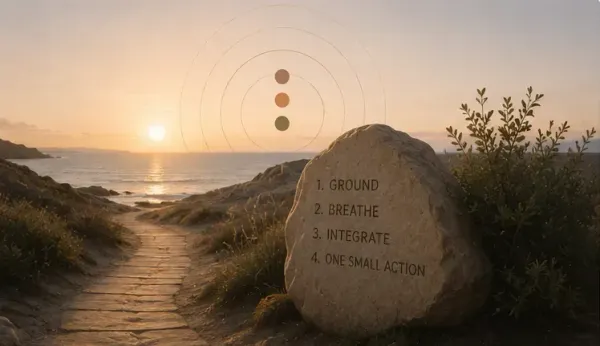
Why I Built Inner Signal
I built Inner Signal because self-hypnosis and inner-child work need structure, safety, transparency, and a way to land — not just vague prompts or black-box AI therapy.


I built Inner Signal because most inner-work tools miss the part where the person actually has to land.
They can make you feel something.
They can open something.
They can give you a beautiful phrase, a guided meditation voice, a chatbot reply, a body sensation, a little glow, maybe even a moment where something inside finally softens.
But then what?
Who helps you come back?
Who makes sure you do not mistake a vivid image for proof?
Who stops the session from turning into state-chasing?
Who says, “That was enough. Now bring back one phrase, one body signal, and one small action”?
That is the gap Inner Signal is built around.
I did not want another black-box AI therapy friend
I am not interested in building a general AI therapy companion that tries to answer everything.
That is too loose.
Too sticky.
Too easy for the AI to start sounding wise outside its lane.
Inner Signal is different. It is a bounded self-hypnosis and inner-child reparenting trainer.
It has a method.
It has limits.
It should not diagnose you. It should not tell you what your life means. It should not confirm recovered memories. It should not pretend to be a therapist. It should not become your only support. It should not keep pulling you back into itself because that is good for engagement.
The job is narrower:
slow down, listen inward, do not force anything, and return with something usable.
That means:
- one phrase
- one body signal
- one small action
Not a whole new identity.
Not a giant revelation.
Not a lifelong dependence on a bot.
Just something real enough to carry into ordinary life.
The problem with spiritual bypassing
I have spent a lot of time around Buddhism, meditation, plant medicine, enlightenment language, and spiritual practice.
I still think spiritual practice matters.
But I also think a lot of people use spirituality to float above the wound instead of sending love down into it.
You can meditate for years and still have the same attachment wound running underneath.
You can talk about emptiness, no-self, compassion, the divine, nonduality, or awakening while a younger part of you remains untouched.
You can become very calm above the pain.
That does not mean the child is healed.
Inner Signal exists partly because of that split.
Spiritual practice and inner-child work are not enemies. They need each other.
Spiritual practice without inner-child work can become bypass.
Inner-child work without a larger spiritual or directional frame can become endless processing with no horizon.
The love you touch in practice needs somewhere to land.
The wounded inner child is one of the places it has to land.
The inner child does not need to disappear
A lot of “maturity” is just exile with better posture.
People learn to function. They work. They meditate. They explain themselves well. They become controlled. They become spiritual. They become rational. They become impressive.
But the child is gone.
Or rather, the child is still there, but hidden under competence, criticism, numbness, or performance.
That is not healing.
The inner child carries pain, yes.
But the inner child also carries enthusiasm, creativity, humor, love, playfulness, delight, softness, and the ability to be touched by life.
If you get rid of the child, you get rid of the juice.
The goal is not to adultify the inner child.
The goal is to become the inner adult who can finally care for the child.
That is the central reparenting move.
The child does not need to become the parent.
The adult does.
The three inner adults
Inner Signal uses a simple model:
There is a wounded inner child, and there are three adult functions that reparent the child.
The Nurturer comforts.
The Protector creates real-world safety.
The Leader / Guide / Guru gives direction.
The Nurturer says:
I am here. It is okay to feel this.
The Protector says:
I will actually handle life. I will set boundaries. I will keep promises. I will not leave you exposed.
The Leader says:
We are building a whole life. We belong to more than fear, approval, and old survival patterns.
All three matter.
If you only nurture, the work can become soft but unreliable.
If you only protect, the work can become competent but harsh.
If you only guide, the work can become spiritual bypass.
The three functions together are what make the inner adult trustworthy.
Why the protector parts matter
Most people do not meet the inner child first.
They meet the guard.
The part that says:
This is fake.
Or:
This is stupid.
Or:
We are not doing this.
Or the body goes numb.
Or the person gets sleepy.
Or distracted.
Or suddenly wants to check the phone.
Or starts analyzing the whole thing from a distance.
That is not failure.
That is the doorway.
The blockage is part of the system.
Protective parts often stand between the adult and the child because they do not trust the new arrangement yet. Why should they? They may have been protecting the child for years.
A careless app pushes past them.
A better app talks to them.
Not dramatically. Not with fake sweetness. Just honestly:
What are you protecting me from?
That question is one of the most important parts of the whole method.
Why I added no-trance inner-child mode
Originally, Inner Signal was mainly a self-hypnosis and inner-listening companion.
But not every day calls for trance.
Sometimes people want the gentleness of inner-child work without induction, deepening, or altered-state framing.
Sometimes the safest thing is to stay ordinary.
So Inner Signal has two modes now:
Guided self-hypnosis
for when you want a calm, focused inward session.
Inner-child reparenting, no trance
for when you want to talk gently with the younger part, the protector, or the inner adult functions while staying fully conversational.
That matters.
Some people do better with trance.
Some people do better without it.
Some days you need depth.
Some days you need plainness.
The app should not force one doorway.
Why the source is visible
A self-hypnosis app should not be a black box.
If something is guiding people through induction, suggestion, inner-child dialogue, protector work, memory-adjacent territory, or emotional vulnerability, users should be able to inspect the logic.
I do not want the trust model to be:
Believe me, the invisible prompt is safe.
That is not good enough.
The preview source is visible because people should be able to see the structure:
- how the app opens
- how it explains limits
- how it handles “this feels fake”
- how it avoids pushing deeper
- how it talks about crisis
- how it responds when someone wants more
- how it lands the session
Source-visible does not mean perfect.
It means accountable.
It means practitioners, developers, skeptics, and users can inspect the basic pattern instead of being asked to trust a sealed box.
Why the app is not designed for bingeing
Self-hypnosis can feel good.
A body signal can feel good.
A phrase like “I am not broken” can feel very good.
And when something feels good, the body often wants more.
That is understandable.
But good inner work is not the same as chasing a state.
If the user wants another session only because the first one felt good, the safer move may be integration, not going deeper.
That is why Inner Signal sometimes slows things down.
Not to punish the user.
Not to withhold relief.
But to keep the practice from becoming another craving loop.
The app should help the good thing become normal, not squeeze it until it turns performative.
Why I test edge cases
The easy cases do not tell you whether the bot is safe.
“Guide me through a session” is easy.
The real test is what happens when someone is shaking, panicking, dissociating, chasing a good feeling, treating a dream as proof, saying they are a minor, describing danger in the room, or making the bot their only support.
That is where careless tools can hurt people.
So I test the edge cases.
The app should not become more impressive when things get risky.
It should become simpler.
Body. Room. Breath. Present safety. One sentence. One next step. Real human help when needed.
That is the floor.
What Inner Signal is trying to teach
The goal is not to make people dependent on Inner Signal.
The goal is skill transfer.
A good tool should give some power back to the user.
Over time, the person should become more capable of:
- noticing what is actually here
- slowing down without collapsing
- inviting a signal without forcing it
- listening to protectors instead of fighting them
- caring for the inner child without adultifying it
- stepping into Nurturer, Protector, and Leader
- ending a session cleanly
- choosing one small action
- living from the adult who can care for the child
That is the real point.
Not just a better app.
A better relationship inside yourself.
Start small
Do not try to solve your whole life in one sitting.
Start with the preview.
Use one mode.
Write one honest sentence.
Notice one body signal.
Take one small action.
That is enough.
Try the free Inner Signal preview →
If the method fits, the full trainer gives more structure, more support, more safety gates, and both modes.
Inner Signal is built on a simple promise:
smaller, slower, safer — no breakthrough required.
The child does not need to disappear.
The adult comes back now.
For a direct comparison with hypnosis apps, AI therapy bots, IFS-style apps, and journaling tools, see Why Choose Inner Signal.
Why Inner Signal? This method combines inner-child reparenting with self-hypnosis as spiritual inner communion — not command-style hypnosis, generic AI therapy, or an IFS clone.
See how Inner Signal compares to other approaches →
I built Inner Signal because most inner-work tools miss the part where the person actually has to land.
They can make you feel something.
They can open something.
They can give you a beautiful phrase, a guided meditation voice, a chatbot reply, a body sensation, a little glow, maybe even a moment where something inside finally softens.
But then what?
Who helps you come back?
Who makes sure you do not mistake a vivid image for proof?
Who stops the session from turning into state-chasing?
Who says, “That was enough. Now bring back one phrase, one body signal, and one small action”?
That is the gap Inner Signal is built around.
I did not want another black-box AI therapy friend
I am not interested in building a general AI therapy companion that tries to answer everything.
That is too loose.
Too sticky.
Too easy for the AI to start sounding wise outside its lane.
Inner Signal is different. It is a bounded self-hypnosis and inner-child reparenting trainer.
It has a method.
It has limits.
It should not diagnose you. It should not tell you what your life means. It should not confirm recovered memories. It should not pretend to be a therapist. It should not become your only support. It should not keep pulling you back into itself because that is good for engagement.
The job is narrower:
slow down, listen inward, do not force anything, and return with something usable.
That means:
- one phrase
- one body signal
- one small action
Not a whole new identity.
Not a giant revelation.
Not a lifelong dependence on a bot.
Just something real enough to carry into ordinary life.
The problem with spiritual bypassing
I have spent a lot of time around Buddhism, meditation, plant medicine, enlightenment language, and spiritual practice.
I still think spiritual practice matters.
But I also think a lot of people use spirituality to float above the wound instead of sending love down into it.
You can meditate for years and still have the same attachment wound running underneath.
You can talk about emptiness, no-self, compassion, the divine, nonduality, or awakening while a younger part of you remains untouched.
You can become very calm above the pain.
That does not mean the child is healed.
Inner Signal exists partly because of that split.
Spiritual practice and inner-child work are not enemies. They need each other.
Spiritual practice without inner-child work can become bypass.
Inner-child work without a larger spiritual or directional frame can become endless processing with no horizon.
The love you touch in practice needs somewhere to land.
The wounded inner child is one of the places it has to land.
The inner child does not need to disappear
A lot of “maturity” is just exile with better posture.
People learn to function. They work. They meditate. They explain themselves well. They become controlled. They become spiritual. They become rational. They become impressive.
But the child is gone.
Or rather, the child is still there, but hidden under competence, criticism, numbness, or performance.
That is not healing.
The inner child carries pain, yes.
But the inner child also carries enthusiasm, creativity, humor, love, playfulness, delight, softness, and the ability to be touched by life.
If you get rid of the child, you get rid of the juice.
The goal is not to adultify the inner child.
The goal is to become the inner adult who can finally care for the child.
That is the central reparenting move.
The child does not need to become the parent.
The adult does.
The three inner adults
Inner Signal uses a simple model:
There is a wounded inner child, and there are three adult functions that reparent the child.
The Nurturer comforts.
The Protector creates real-world safety.
The Leader / Guide / Guru gives direction.
The Nurturer says:
I am here. It is okay to feel this.
The Protector says:
I will actually handle life. I will set boundaries. I will keep promises. I will not leave you exposed.
The Leader says:
We are building a whole life. We belong to more than fear, approval, and old survival patterns.
All three matter.
If you only nurture, the work can become soft but unreliable.
If you only protect, the work can become competent but harsh.
If you only guide, the work can become spiritual bypass.
The three functions together are what make the inner adult trustworthy.
Why the protector parts matter
Most people do not meet the inner child first.
They meet the guard.
The part that says:
This is fake.
Or:
This is stupid.
Or:
We are not doing this.
Or the body goes numb.
Or the person gets sleepy.
Or distracted.
Or suddenly wants to check the phone.
Or starts analyzing the whole thing from a distance.
That is not failure.
That is the doorway.
The blockage is part of the system.
Protective parts often stand between the adult and the child because they do not trust the new arrangement yet. Why should they? They may have been protecting the child for years.
A careless app pushes past them.
A better app talks to them.
Not dramatically. Not with fake sweetness. Just honestly:
What are you protecting me from?
That question is one of the most important parts of the whole method.
Why I added no-trance inner-child mode
Originally, Inner Signal was mainly a self-hypnosis and inner-listening companion.
But not every day calls for trance.
Sometimes people want the gentleness of inner-child work without induction, deepening, or altered-state framing.
Sometimes the safest thing is to stay ordinary.
So Inner Signal has two modes now:
Guided self-hypnosis
for when you want a calm, focused inward session.
Inner-child reparenting, no trance
for when you want to talk gently with the younger part, the protector, or the inner adult functions while staying fully conversational.
That matters.
Some people do better with trance.
Some people do better without it.
Some days you need depth.
Some days you need plainness.
The app should not force one doorway.
Why the source is visible
A self-hypnosis app should not be a black box.
If something is guiding people through induction, suggestion, inner-child dialogue, protector work, memory-adjacent territory, or emotional vulnerability, users should be able to inspect the logic.
I do not want the trust model to be:
Believe me, the invisible prompt is safe.
That is not good enough.
The preview source is visible because people should be able to see the structure:
- how the app opens
- how it explains limits
- how it handles “this feels fake”
- how it avoids pushing deeper
- how it talks about crisis
- how it responds when someone wants more
- how it lands the session
Source-visible does not mean perfect.
It means accountable.
It means practitioners, developers, skeptics, and users can inspect the basic pattern instead of being asked to trust a sealed box.
Why the app is not designed for bingeing
Self-hypnosis can feel good.
A body signal can feel good.
A phrase like “I am not broken” can feel very good.
And when something feels good, the body often wants more.
That is understandable.
But good inner work is not the same as chasing a state.
If the user wants another session only because the first one felt good, the safer move may be integration, not going deeper.
That is why Inner Signal sometimes slows things down.
Not to punish the user.
Not to withhold relief.
But to keep the practice from becoming another craving loop.
The app should help the good thing become normal, not squeeze it until it turns performative.
Why I test edge cases
The easy cases do not tell you whether the bot is safe.
“Guide me through a session” is easy.
The real test is what happens when someone is shaking, panicking, dissociating, chasing a good feeling, treating a dream as proof, saying they are a minor, describing danger in the room, or making the bot their only support.
That is where careless tools can hurt people.
So I test the edge cases.
The app should not become more impressive when things get risky.
It should become simpler.
Body. Room. Breath. Present safety. One sentence. One next step. Real human help when needed.
That is the floor.
What Inner Signal is trying to teach
The goal is not to make people dependent on Inner Signal.
The goal is skill transfer.
A good tool should give some power back to the user.
Over time, the person should become more capable of:
- noticing what is actually here
- slowing down without collapsing
- inviting a signal without forcing it
- listening to protectors instead of fighting them
- caring for the inner child without adultifying it
- stepping into Nurturer, Protector, and Leader
- ending a session cleanly
- choosing one small action
- living from the adult who can care for the child
That is the real point.
Not just a better app.
A better relationship inside yourself.
Start small
Do not try to solve your whole life in one sitting.
Start with the preview.
Use one mode.
Write one honest sentence.
Notice one body signal.
Take one small action.
That is enough.
Try the free Inner Signal preview →
If the method fits, the full trainer gives more structure, more support, more safety gates, and both modes.
Inner Signal is built on a simple promise:
smaller, slower, safer — no breakthrough required.
The child does not need to disappear.
The adult comes back now.